
Star Wars Board Games: strategy board game
How Star Wars Rebellion Works
Fantasy Flight Games released Star Wars Rebellion in 2016. One player commands the Empire, the other the Rebel Alliance. It’s a long, asymmetric strategy duel built around a hidden base, best suited to experienced players.
- 2016
- 2-4 players
- 180-240 minutes
- Ages 14+
- strategy board game
- Fantasy Flight Games
Designers: Corey Konieczka
One side hides while the other hunts. Here’s how a round unfolds.
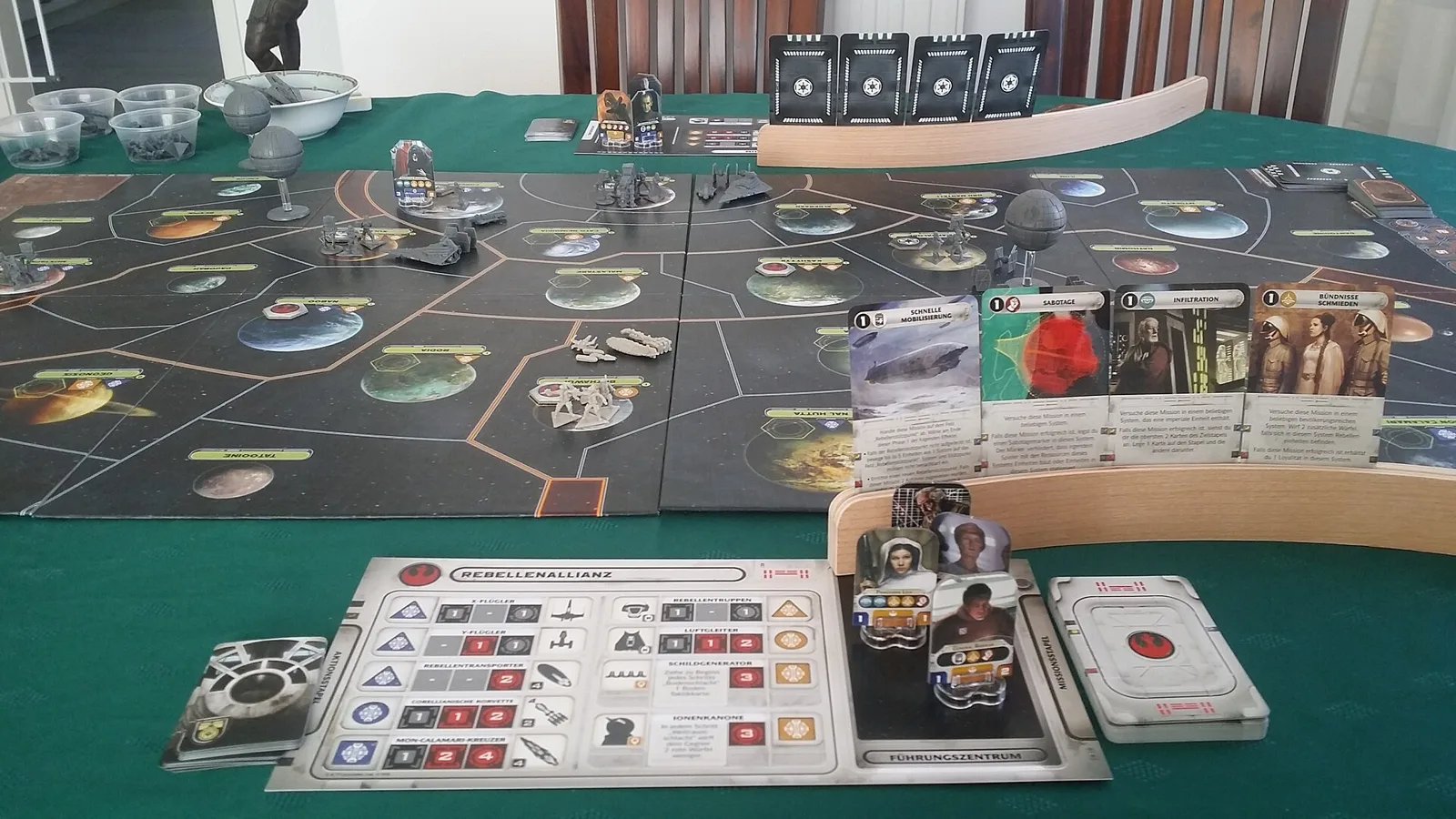

Each Rebellion round has three phases, and the game continues through rounds until one side wins. The steps below follow the Learn to Play booklet. For a broader look at Star Wars tabletop games, see the Star Wars board games page.
The Rebels win when the reputation marker reaches the time marker.
A quick guide to one Star Wars Rebellion round
A round runs through three phases: assignment, command, and refresh. Here are the steps in order.
Imperial ground units reveal the base when they enter its system.
- Step 1:
Assignment phase: The Rebel player goes first. Each player places a mission card facedown and assigns one or two leaders to it. Any leaders left over stay in the leader pool.
- Step 2:
Command phase: The Rebel player goes first, then players alternate turns. On a turn, activate a system, reveal a mission, or pass.
- Step 3:
To activate a system, put a leader from your pool there, then move units from adjacent systems into it. Ships can carry ground units only if they have transport capacity.
- Step 4:
To reveal a mission, turn over a facedown card and name the system. Your opponent can send one leader to oppose it. Both sides roll dice for their matching skill icons.
- Step 5:
If both sides have units in one system, resolve combat: space battle first, then ground battle. Repeat until one side is gone or retreats.
- Step 6:
Refresh phase: Draw two mission cards. The Imperial player launches probe droids, and leaders return to their pools. The Rebel player draws an objective card.
- 7Step 7:
Next, move the time marker one space. This may let players recruit leaders or queue units to build. Finally, each player deploys units that leave the build queue.
A round summary skips the three things new players usually ask about: setup, mission results, and how combat works. We cover those next, then explain the two ways to win. Prefer fleet battles to secret missions? Star Wars Armada offers a tighter two-player alternative.
Star Wars Rebellion rules, made clear
Setup
Each player takes a faction, including its miniatures, leaders, loyalty markers, faction sheet, mission cards, and action cards. If you can’t agree on factions, choose randomly.
Each player puts the four leaders without a recruit icon in the leader pool on the faction sheet. Set leaders with recruit icons beside the board.
Set the two board halves side by side. Put the time marker on space 1 and the reputation marker on space 14 of the track.
Sort objective cards by the number on their backs, shuffle each pile, and stack them with pile I on top. The Rebel player draws one objective and keeps it secret.
The Rebel player secretly chooses a system for the hidden Rebel base and places its probe card facedown under the base “Location” space. For a first game, choose one that isn’t next to any Imperial units.
Each player takes the four starting missions and draws two more mission cards for a starting hand. Then place each side’s starting units as shown in the booklet’s first-game setup.
Turn by turn
Assignment phase
Starting with the Rebel player, players secretly assign leaders to missions. Place a mission card facedown by the faction sheet with one or two leaders. Its skill requirement appears in the upper left corner.
Activating a system
Take a leader from the pool and place it in any system. Then move ships there from adjacent systems if you like. If Imperial ground units enter the system with the Rebel base, reveal the base before combat.
Revealing a mission
Flip a facedown mission card and name the system. Cards say “attempt” or “resolve.” A resolved mission always happens. An attempted mission works only if it succeeds, and the opponent can send a leader to oppose it.
Opposed missions
Each side rolls dice for the matching skill icons on its leaders. Count the successes: the side with more succeeds at the mission. A tie means failure.
Combat
Both sides may add a leader, then draw tactic cards based on that leader’s values. Each combat round goes from space battle to ground battle, followed by a chance to retreat. Combat continues as long as both sides have units in the same theater.
Refresh phase
Players draw missions, the Empire launches probe droids, leaders return, and the Rebels draw an objective. Move the time marker forward. The recruit and build icons on its new space determine what happens next.
End of the game and scoring
There’s no scoring track. The Imperial player wins immediately by conquering the system with the Rebel base: an Imperial unit must be there, with no Rebel units. The Rebel player wins immediately if the reputation and time markers land on the same space of the track.
Key rules
The hidden base
Only the Rebel player knows the base’s location. Moving units to or from its space reveals a system next to it. The base is also revealed if Imperial loyalty or ground units are in its system.
Probe droids
Each round, the Imperial player draws two probe cards. Each names a system that doesn’t contain the base, helping the Empire narrow its search without attacking every planet.
Loyalty and subjugation
Loyalty indicates which side a system supports. Systems with loyalty can build units. Imperial ground units in a system without Imperial loyalty subjugate it, letting the Empire build there.
Reputation and objectives
Playing Rebel objective cards moves the reputation marker. The Rebels need it to catch the time marker, making objectives their most common path to victory.
The Death Star
The Imperial player needs a Research and Development mission to draw a Superlaser Online card. The Death Star can then destroy a system and all Rebel ground units there. It cannot retreat from combat.
Tips for your first game
- Use the booklet’s first-game setup. It sets fixed starting units and tells the Rebel player to choose a base that isn’t next to Imperial units.
- Rebels: don’t take on the Empire head-on. The booklet points out that the Rebels are outnumbered. Stay hidden and build reputation to win.
- Imperials: spread out. The booklet says your best shot at ending the rebellion is to search the galaxy for the hidden base.
- Keep the Rules Reference handy. The booklet skips some exceptions, and the Rules Reference can answer questions as they come up.
- For games with more than two players, read the team game section first. Each team splits its leaders and jobs between an Admiral and a General.
Each probe card names a system where the base isn’t.
The rules explain how Rebellion plays. This section looks at its designers, release date, and the part of the saga it recreates. Then we’ll go through the box contents, handy before an evening of galactic conquest.
The game and the Galactic Civil War
A tied mission roll means the player attempting the mission fails.
The game
Design and release
Corey Konieczka designed Star Wars: Rebellion for Fantasy Flight Games. Ars Technica’s review lists March 31, 2016 as the release date and says the board game loosely draws on the 1998 Star Wars: Rebellion video game.
Teams and length
The box lists 2 to 4 players, and Fantasy Flight Games gives a play time of 180 to 240 minutes. The Learn to Play booklet explains team play for three or four players, with an Admiral and a General on each side.
The film or series it covers
The game covers the Galactic Civil War between the Rebel Alliance and the Galactic Empire, with leaders and missions from the Original Trilogy era. The booklet quotes lines from Return of the Jedi.
Players send famous characters on secret missions and command troops in battles across the galaxy. The Rebels can’t win a straight fight, so they hide their base. The Empire has far more forces and searches for it.
Scenes and story beats in the game
- 1
The Empire’s Death Star, described in the booklet’s introduction as powerful enough to destroy any opposition, appears as a unit in the game.
- 2
The Rebel mission Rapid Mobilization lets the player move the base to a new location.
- 3
The Imperial mission Capture Rebel Operative can take a Rebel leader prisoner. The Empire can later attempt missions against that captured leader.
There are a lot of pieces in a game this size, so it helps to see what’s in the box before clearing the table. The list follows the Learn to Play booklet. The expansion section afterward explains what Rise of the Empire adds for players who want more leaders.
The Rebels win when the reputation marker reaches the time marker.
What’s inside the Star Wars Rebellion box
- 1 Learn to Play booklet and 1 Rules Reference
- 1 game board, split into two halves
- 153 plastic miniatures (89 Imperial and 64 Rebel)
- 25 leaders with plastic stands (12 Imperial and 13 Rebel)
- 68 mission cards (39 Imperial and 29 Rebel) and 34 action cards
- 30 tactic cards (15 ground and 15 space), 31 probe cards, and 15 objective cards
- 10 custom dice (5 black and 5 red)
- 2 faction sheets, loyalty and subjugation markers, damage markers, sabotage markers, a time marker, and a reputation marker
Star Wars Rebellion expansion: Rise of the Empire
Rise of the Empire 2017
Fantasy Flight Games said in 2017 that the expansion was inspired largely by Rogue One: A Star Wars Story. It adds eight leaders, 36 plastic miniatures, five target markers, two attachment rings, three dice and more than 100 cards.
Star Wars Rebellion rules FAQ
How long does a game of Star Wars Rebellion take?
Fantasy Flight Games lists 180 to 240 minutes, so set aside most of an evening. The game ends immediately if the Empire conquers the base or the Rebel markers meet on the track.
How do the Rebels win in Star Wars Rebellion?
The Rebels win when the reputation marker reaches the time marker’s space. Playing objective cards is the most common way to gain reputation. No need to conquer the galaxy.
How does the Empire find the Rebel base?
The Imperial player draws two probe cards each round. Each names a system where the base isn’t. The base is also revealed if the Empire has loyalty or ground units in its system.
Can you play Star Wars Rebellion with more than two players?
Yes. Three or four players can play on teams, with up to two players per side. Each team has an Admiral and a General, who handle different leaders and jobs.
What does the Rise of the Empire expansion add to Star Wars Rebellion?
Fantasy Flight Games lists eight leaders, 36 plastic miniatures, five target markers, two attachment rings, three dice, and more than 100 cards. The expansion draws largely on Rogue One.
What age is Star Wars Rebellion for?
The box recommends ages 14 and up. With its long play time and complex rules, it also suits players who already enjoy strategy board games.
Imperial ground units reveal the base when they enter its system.
Each probe card names a system where the base isn’t.
Sources
- Fantasy Flight Games: Star Wars: Rebellion product page fantasyflightgames.com
- Fantasy Flight Games: Star Wars: Rebellion Learn to Play (PDF) cdn.svc.asmodee.net
- Fantasy Flight Games: A Rebellion Built on Hope (2017) fantasyflightgames.com
- Ars Technica: Star Wars: Rebellion review (2016) arstechnica.com